Putting Mat Practice: Drills for Speed, Line and Start
Putting mat practice works when each session has one job: speed, line or start direction. Use this drill plan with set reps, a weekly progression and a setup checklist.
The Kesslund Team
November 12, 2026 · 9 min read
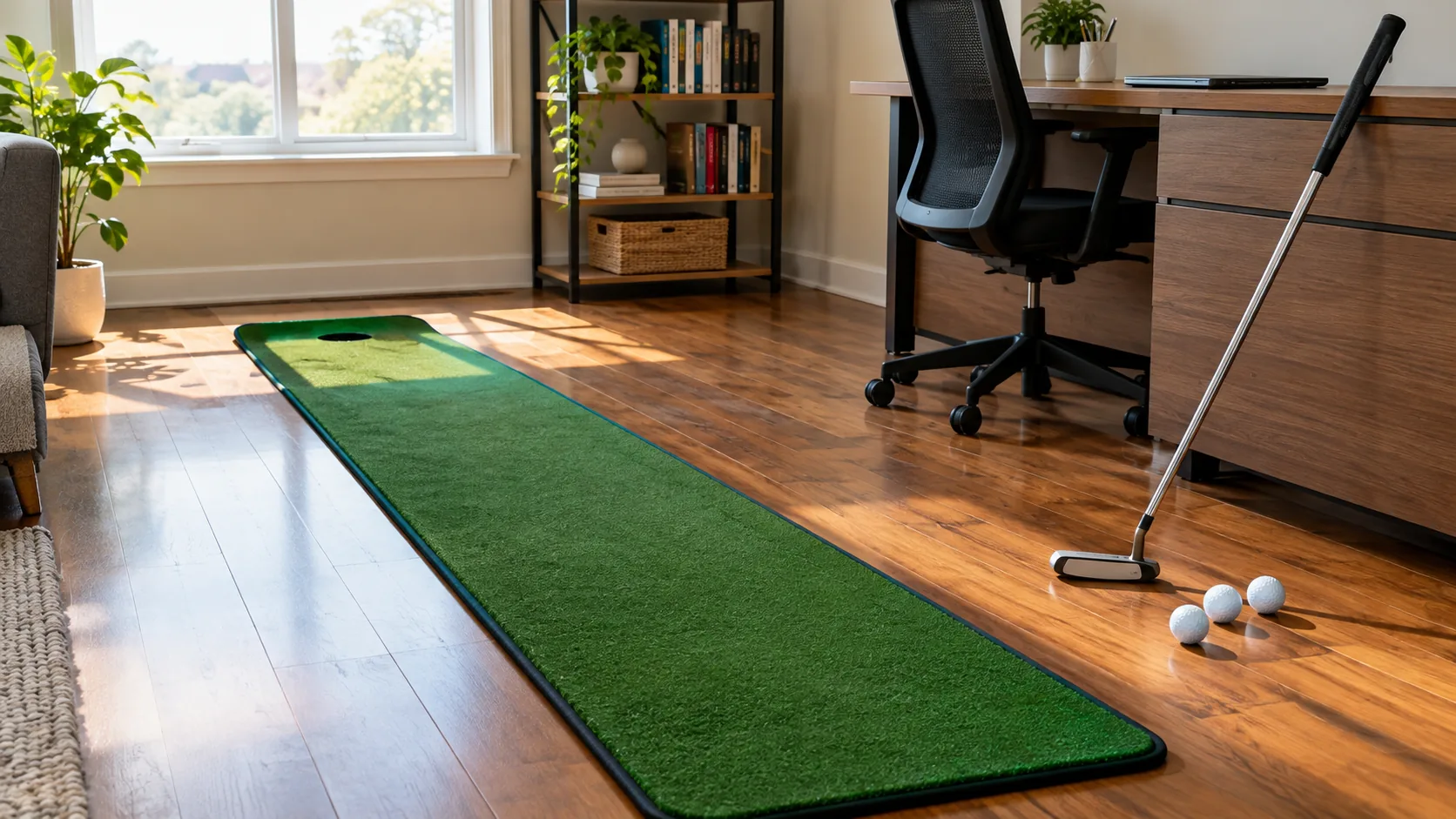
Putting mat practice works when every session trains one thing: how far the ball rolls (speed), where it travels (line), or where it leaves the putter face (start). Pick one focus, hit a set number of putts, score them, and move to the next drill only when the score holds. The plan below gives you the setup, the drills, the reps and a four-week progression.
A mat does not copy every green you play, so use it as a place to repeat your stroke and your routine. The ball return, the alignment guides and a flat floor do the rest.
The plan at a glance
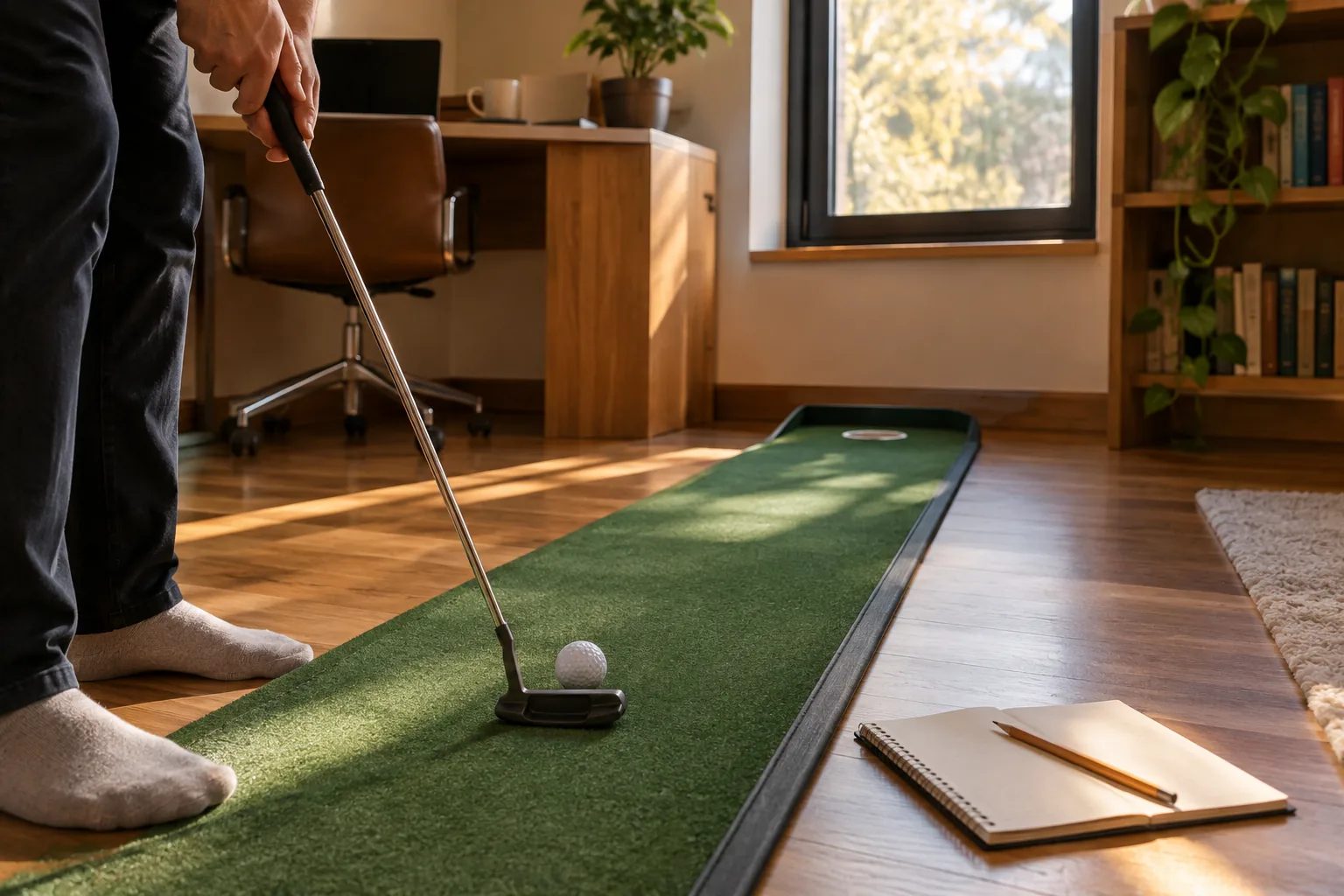
Each session uses three blocks: a short warm-up, one main drill, and a pressure finish. Keep a pencil and a small notebook next to the mat so every drill ends with a number.
| Block | What you do | Reps |
|---|---|---|
| Warm-up | Easy putts from one spot, focus on a steady stroke | 10 putts |
| Main drill | One speed, line or start drill from the sections below | 20 to 30 putts |
| Pressure finish | Make-or-restart game with a running score | 10 to 15 putts |
That is 40 to 55 putts per session, which fits in a hallway, a spare room or on a patio.
Set up the mat before the first putt
Drills only mean something if the surface is the same every time. A mat that curls, slides or sits on a slope will teach your eyes the wrong thing. Run through this checklist at the start of each session.
- Choose a flat floor. Hardwood, tile, carpet and concrete all work with a mat that grips them, but check that the floor itself is level.
- Unroll the mat and let the edges settle. If a corner lifts, flatten it by hand and let it settle before you start.
- Square the mat to a wall or baseboard so the alignment guides point where you think they do.
- Mark your start spot and your target distance. Use a coin, a ball marker or a club shaft laid on the floor past the end of the mat.
- Clear the space behind you for the backswing and the follow-through, and keep pets and kids out of the stroke zone.
If you are shopping for gear, the Court, Golf & Backyard Games collection lists other practice items for the yard and garage.
A mat built for repeating reps
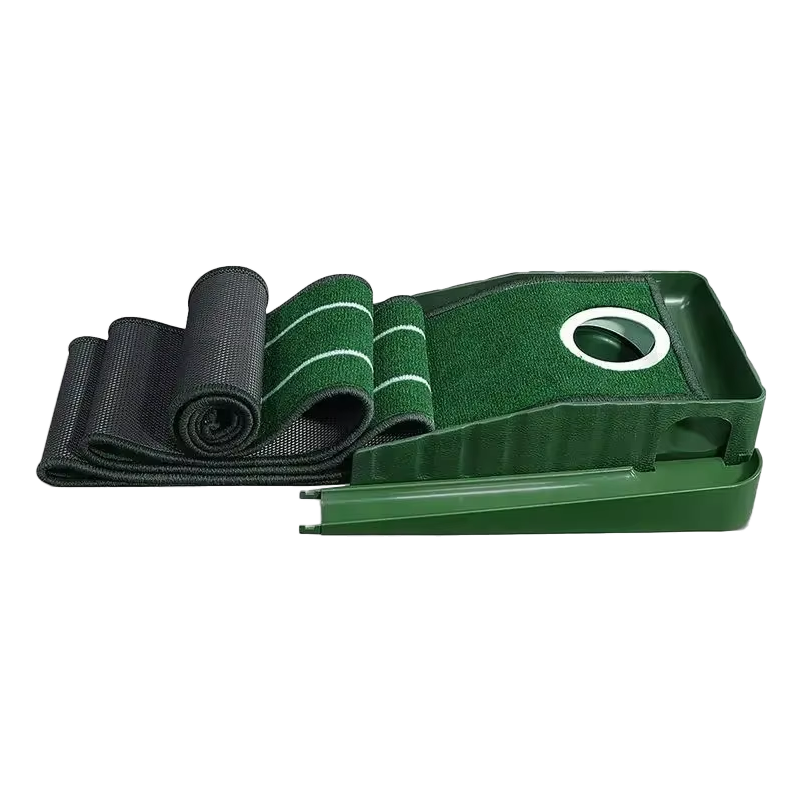
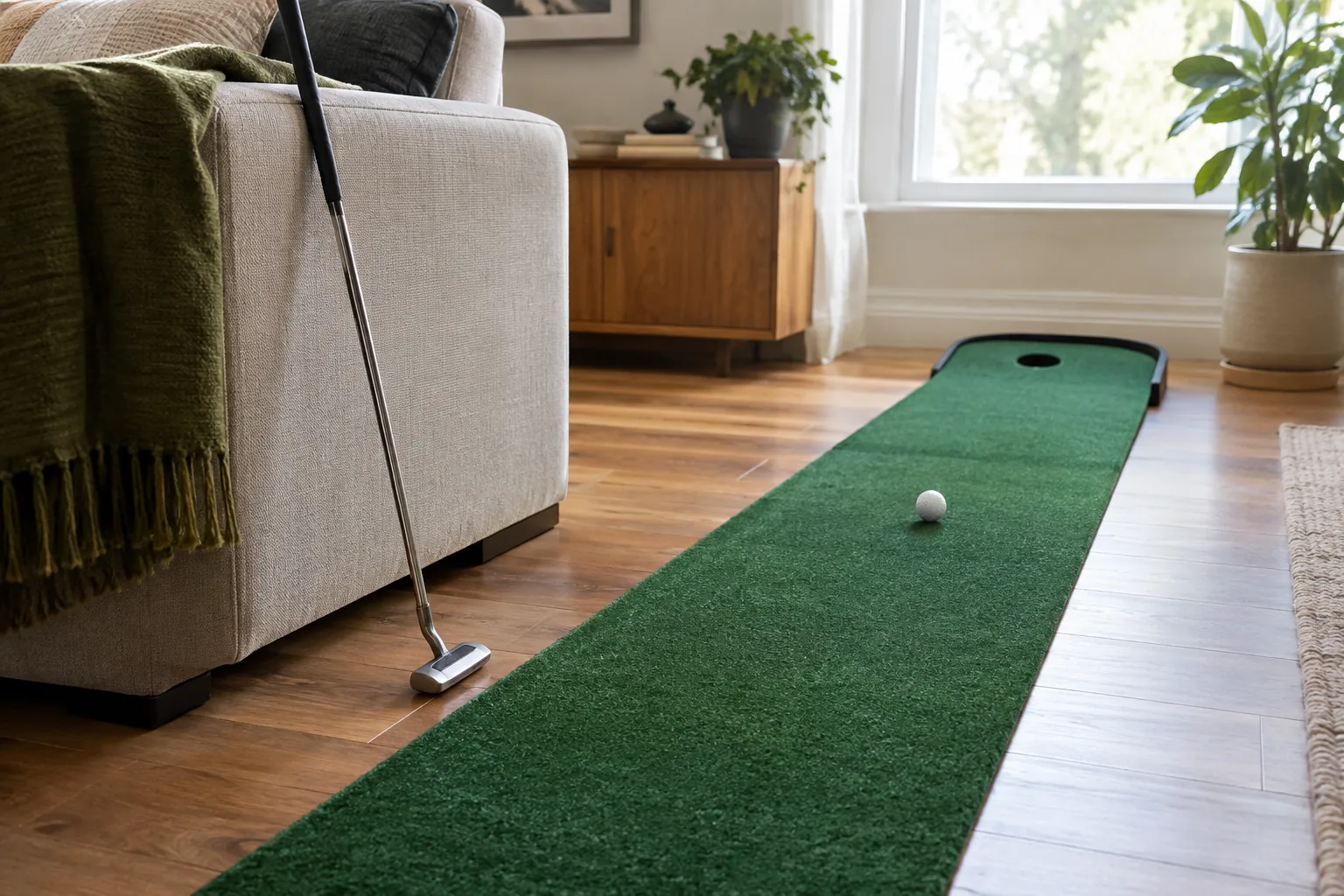
The PureStroke Pro is a golf putting mat with a turf surface made of uniform-density fibers and built-in alignment guides for lining up stance, ball position and putter path. A ball return track runs along the mat and sends the ball back toward your starting spot using gravity and a gentle slope, with no electronics and no batteries. The weighted-edge backing helps the mat lie down after you unroll it, and the Grip-Lock backing sits on hardwood, tile, carpet and concrete.
Because the track returns the ball, you can stay over the putt and keep your routine going instead of walking to collect balls. Set the track to the putting distance you want, then work through the drills below.
 In this guidePureStroke Pro$169.99View
Speed drills: control the distance first
Speed decides whether a putt finishes near the hole, and it affects how much a putt curves. Work on it before line, because a good line with poor distance still leaves a long second putt.
Drill 1: Stop-on-the-line
Lay a club shaft across the floor at the end of the mat as your target line. If the ball return track gets in the way, place the shaft beside the track as a distance mark instead. Hit 10 putts from your start spot and try to stop each ball just short of or on the shaft. Score one point for each ball that stops within a putter-grip length of the line.
Repeat from a second, longer distance if your mat allows it. A score of 7 out of 10 is a sensible mark before you move on.
Drill 2: The ladder
Mark three stations along the mat, for example at 3, 6 and 9 feet, or whatever distances your mat allows. Hit one ball to each station in turn, then repeat the sequence for 5 rounds. Change the order each round (near, far, middle) so you must read the distance again every time instead of copying the last stroke.
Drill 3: Long-short-long
Hit one putt to your longest distance, one to your shortest, then one to the middle. The point is to feel how stroke length changes, not to hit harder. Keep the tempo steady and let the backstroke grow or shrink.
Drill 4: Three-ball finish
Hit three balls toward the same target, one after another. Aim for all three to finish within one putter-head length of each other. This shows how consistent your strike is, and it is a useful check on days when your stroke feels off.
Line drills: read it, aim it, hold it
Line drills train your eyes and your aim. The alignment guides on the mat give you a fixed reference, so you can see when your stance or putter path drifts away from it.
Drill 5: Guide-line stroke
Set your eyes over the ball and line up the putter face with the guide. Make 20 putts, and after each one check whether the ball stayed on the guide line. If it veers, look at where the putter face pointed at impact rather than adjusting your aim every time.
Drill 6: The putter gate
At address, place a tee or coin on each side of the putter head, just wider than the head. Swing the putter back and through without touching either marker. Do 3 sets of 10 and note how many clean strokes you make in each set.
Drill 7: Eyes-closed stroke check
Take your stance, look at the target, then close your eyes for the stroke. Open them and see where the ball finished. If it keeps missing to one side, your setup may be aimed off, so square your shoulders and feet to the guide and try again.
Drill 8: Make a break with a shim
A flat mat has no break, but you can add one. Slide a thin book or folded towel under one side of the mat to make a slight slope, and check that the mat lies flat over the shim with no folds or gaps, and that the ball return track still sits properly. Aim outside the target, let the ball curve, and note how the speed changes the curve. Keep the slope slight and keep your footing steady.
If you also play with a distance device, see Using a Rangefinder in Golf for how slope and distance information fits into your on-course routine.
Field note
Set the ball on the alignment guide with its stripe pointing the same way every time. When the ball sits the same way each putt, you can tell whether a miss comes from the start direction or from the read.
Start drills: where the ball leaves the face
Start line is the direction the ball begins to roll. If the ball leaves on the wrong path, no read can save the putt. These drills isolate the first few inches of the roll.
Drill 9: Short-range start
Use the shortest distance your mat allows. Set up on the guide and hit 20 putts, watching only the first foot of roll. Count the balls that start on the guide line. Distance does not matter in this drill, only the start direction.
Drill 10: Coin target
Place a coin about a foot in front of the ball on your target line. Roll the ball over the coin without moving it. Hit 10, then move the coin another foot farther from the ball, toward the target, and hit 10 more. This gives your eyes a small target to track.
Drill 11: Same-spot repeat
Use the ball return to hit the same putt from the same spot for a full set of 12 reps, without changing your setup. The return track sends the ball back to your start area, so you can keep your pre-putt routine intact. Note how many rolls start on the same line.
Drill 12: Routine reset
Build a fixed routine: read, one practice stroke, step in, look at the target, stroke. Run the routine on every putt in a 10-putt set, even the ones that miss. A repeatable routine makes your start line easier to check because the other variables stay constant.
A four-week progression for putting mat practice
A plan beats random putts. Spread the drills across the week, give each one a score, and raise the target only after you meet it in two sessions in a row. The table assumes three sessions a week of 40 to 55 putts each.
| Week | Session 1 | Session 2 | Session 3 |
|---|---|---|---|
| 1 | Stop-on-the-line (Drill 1) | Short-range start (Drill 9) | Guide-line stroke (Drill 5) |
| 2 | Ladder (Drill 2) | Putter gate (Drill 6) | Coin target (Drill 10) |
| 3 | Long-short-long (Drill 3) | Eyes-closed stroke check (Drill 7) | Same-spot repeat (Drill 11) |
| 4 | Three-ball finish (Drill 4) | Shim break (Drill 8) | Routine reset (Drill 12) |
Pressure games to finish each session
Close with a game that gives your last putts some weight. Two simple ones work on any mat.
- Restart game: make 5 putts in a row from your chosen distance. If you miss, the count goes back to zero.
- Station game: play 9 putts, each to a different station. Score two points for a ball that finishes on target, one for a ball that finishes close, zero for the rest, and try to beat your last total.
Write down every score. Seeing the numbers over several weeks shows how your putting changes, and it points to which skill to drill next.
Common mistakes on a practice putting mat
Wasted sessions often come from a few habits you can change. Check these before you decide the mat is the problem.
- Changing the drill every few putts. Stay with one drill for its full set of reps so the score means something.
- Skipping the setup. A mat that is crooked or lifting at the corners makes the guide lines useless.
- Hitting hard to make up for short stops. Keep the tempo the same and change the stroke length instead.
- Ignoring the misses. Note which side the misses fall on, since a pattern points to aim, face angle or path.
- Practicing only straight putts. Use the shim drill so you do not train only one shape of putt.
- Going too long. Fatigue makes the stroke sloppy, so stop when the reps lose focus.
Moving the work to the course
On a real green, grass, grain and slope all change the roll, so use the mat for the parts that carry over: the routine, the aim, the tempo and the strike. Before a round, spend a few minutes on the practice green matching your mat speed notes with the real surface. Then keep your routine the same on the course.
Care and storage between sessions
A mat that is looked after stays flat and consistent. Roll the mat up and store it in the included storage case. The PureStroke Pro rolls up for storage in a closet or under a bed, and the protective storage case is included for carrying it to the office or on a trip.
- Before each session, brush debris off the turf and wipe the ball.
- Do not leave the mat folded or under a heavy object that leaves a crease.
- Check the floor for dust, since grit under the backing can lift the mat.
- Follow the manufacturer's instructions that come with the mat.
With a flat mat, a short checklist and one drill at a time, putting mat practice becomes a routine you can repeat on any floor.