Resistance Bands With Handles Workouts: Full-Body Routines
Four full-body routines sorted by anchor point and band tension, plus the setup and inspection checks to run before every session.
The Kesslund Team
November 22, 2026 · 9 min read
Resistance bands with handles workouts come down to two choices: where the band is anchored and how many bands you stack on the handles. Pick an anchor point (under your feet, in a doorway, at your ankles or from a seat), set a tension you can move through with steady form, and run the routines below.
This guide gives you four routines sorted by anchor point, a tension table and a checklist for band inspection before each session. The examples use a kit with stackable bands, handles, ankle straps and a door anchor, but the same moves apply to any tube bands with handles.
Setup and band inspection before every session
A band is a stretched piece of elastic under load, so give it a look every time. Take a moment for the checklist before you clip anything on.
- Run your fingers along each band and look for nicks, cracks, thin spots or a sticky, dry surface. Retire any band that shows them.
- Check every clip, handle and strap for wear, and make sure each connection is fully closed.
- Look at the floor: clear space around you, with dry shoes or bare feet on a non-slip surface.
- If you use a doorway, secure the foam door anchor as the manual describes and confirm the door is closed and fully latched before you pull.
- Start with a low tension and a slow first rep to see where the band loads.
- Ask a qualified trainer if a move does not feel right for you, and follow the manual for your kit.
Keep bands out of direct sun and away from sharp edges, zippers and rough concrete. Store them loose, not knotted or pinched under furniture.
How to choose band tension
Tension depends on the move, not on a single number for your whole body. Glute and back moves take a stack of several bands, while shoulder moves take one, so expect to change the setting during one session.
With a stackable kit, you clip one band or several to the handles or ankle straps. Stackable bands let you set resistance for each exercise instead of living with one fixed setting.
| Setting | How to set it | Used for |
|---|---|---|
| Low | One band clipped on | Lateral raises, face pulls, triceps extensions, warm-up sets |
| Medium | Two or three bands stacked | Chest presses, rows, biceps curls, squats |
| High | Four or more bands stacked | Kickbacks, deadlifts, lat pulldowns |
Use this check: you should finish the last rep of each set with the same form as the first. If your back arches, your shoulders hike up or the band snaps you back, remove a band. If you could do several more clean reps, add one.
Resistance bands with handles workouts by anchor point
The anchor decides which muscles you can reach. Sorting the session by anchor means you set up once per routine instead of changing positions every exercise.
| Anchor point | Setup | Moves |
|---|---|---|
| Under your feet | Stand on the band, hold the handles | Squat to overhead press, bent-over row, Romanian deadlift, lateral raise, biceps curl, pull-apart |
| Door anchor | Foam anchor secured in a standard doorway, band at chest, hip or high position | Chest press, row, face pull, lat pulldown, woodchop |
| Ankle straps | Strap on the ankle, band clipped to the strap, other end held or anchored | Kickback, hip abduction, leg extension, standing leg curl |
| Seated, band under the feet | Sit on a chair or the floor, band around the feet, handles in your hands | Seated row, seated overhead press, triceps extension |
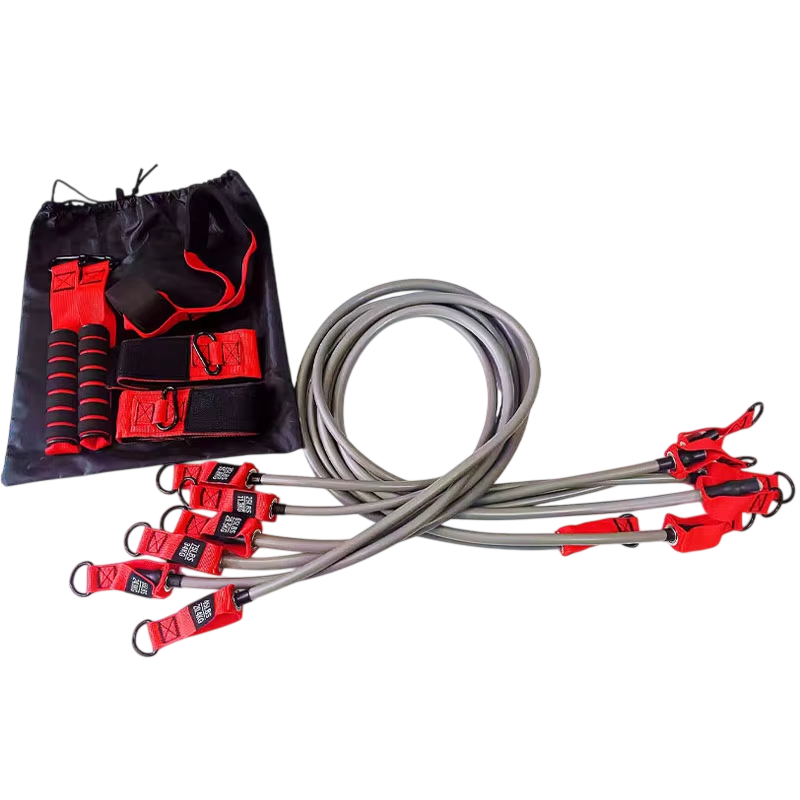
The SinewStack kit covers these setups: six color-coded bands, two padded handles, two sponge-lined ankle straps and a foam door anchor. The anchor gives a doorway a fixed pulling point, and you can skip it for standing moves.
 In this guideSinewStack$59.99View
Routine 1: standing moves with no anchor
Run this one in a hotel room, a park or a spare corner. You need only the bands, the handles and some floor. Use a low to medium stack and move slowly.
The moves
- Squat to overhead press: stand on the band with feet shoulder-width apart, handles at shoulder height with palms facing forward. Sit your hips back, stand, and press the handles overhead. 10 to 12 reps.
- Bent-over row: hinge forward with a flat back, arms straight down holding the handles, then pull elbows toward your ribs. 10 to 12 reps.
- Romanian deadlift: stand on the band with feet hip-width apart and soft knees, and slide the handles down your thighs. Engage your core and stand tall. 10 reps.
- Lateral raise: arms at your sides, lift the handles out to shoulder level, then slowly lower. 12 reps.
- Biceps curl: stand on the band with elbows at your sides, curl the handles toward your shoulders, then slowly lower to the starting position and repeat. 12 reps.
- Pull-apart: hold the handles with arms straight at shoulder height, spread them apart, and return slowly. 12 reps.
Rest between rounds of the six moves, and run two or three rounds. If your toes lift while you stand on a band, shift your feet back and keep your weight through the whole foot.
Routine 2: door anchor pulling and pressing
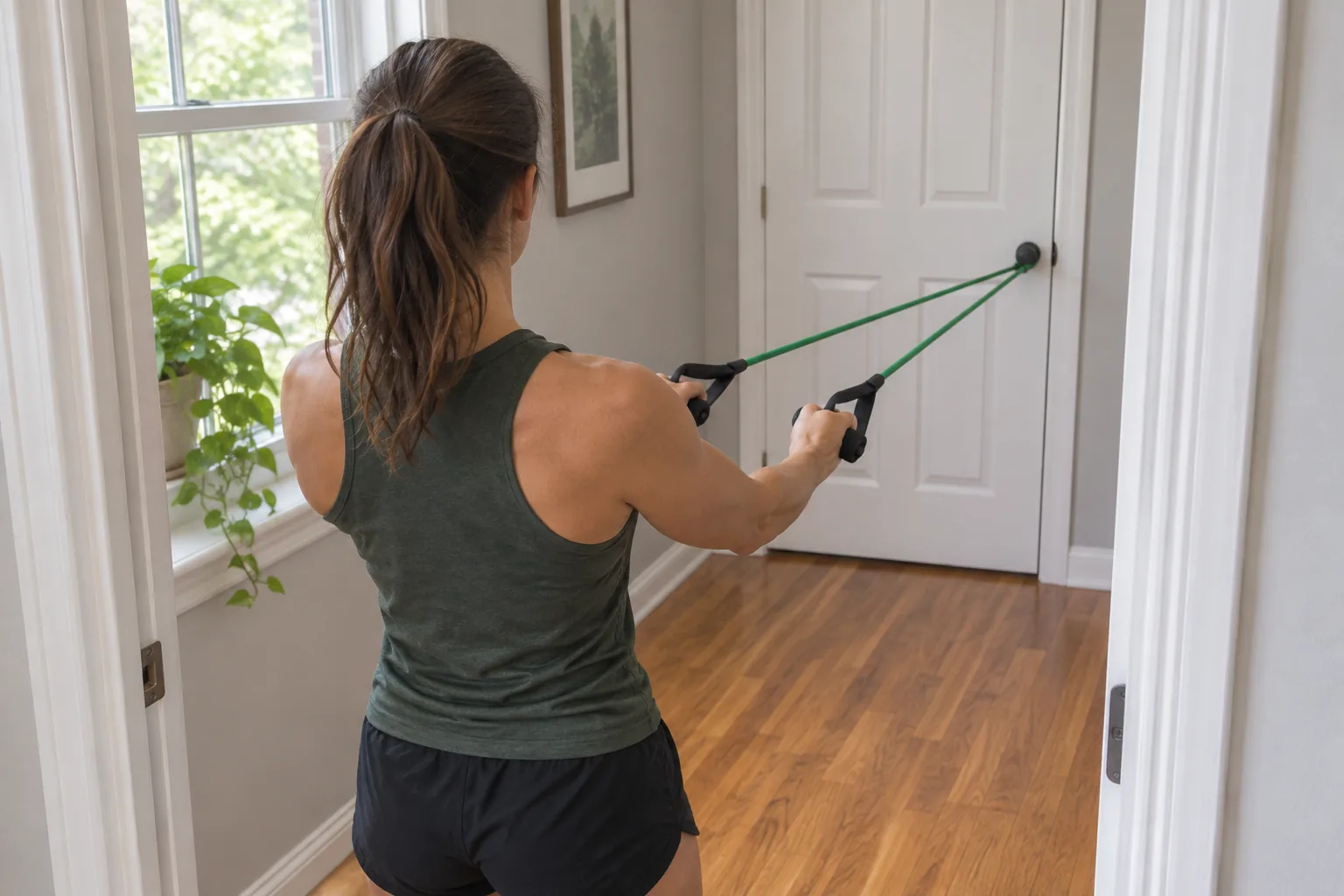
A doorway gives you a fixed point, which opens up pushing and pulling patterns that standing moves cannot copy. The foam anchor is dense, soft foam that cushions the door and frame. Follow the manual for placement, and pull away from the door, keeping the band in a straight line with the anchor.
Stand far enough back that the band has slight tension at the start. Set a medium stack for presses and rows and a low stack for the shoulder work.
Anchor at chest height
- Standing chest press: face away from the door, one foot forward, press both handles out until your arms are straight. 10 to 12 reps.
- Standing row: face the door, step back, and pull your elbows behind you while squeezing your shoulder blades. 12 reps.
- Face pull: face the door and pull the handles toward your face with elbows high. Use one band. 12 to 15 reps.
Anchor at the top or hip
- Lat pulldown: with the anchor high, kneel facing the door and pull the handles down toward your shoulders. 10 to 12 reps.
- Woodchop: anchor at hip height, stand sideways to the door and rotate the handles across your body, keeping hips square. 10 per side.
Rest between exercises. For the anchor check, tug the band firmly with a small pull before you load it fully, and stop if the anchor shifts or the door moves. If you are unsure the door and frame suit an anchor, skip this routine and ask a qualified professional.
Routine 3: ankle strap leg and glute work
The sponge-lined ankle straps pad the ankle during leg work, so you can clip a band to the strap and move your leg against it. If you are also considering extra load around the ankle, the ankle weights guide explains how to judge fit and pounds.
Hold a chair, wall or door frame for balance. Use a medium to high stack on the working leg and keep the standing leg slightly bent.
- Standing kickback: strap on one ankle, other end of the band anchored low or held under the standing foot. Drive the heel back without arching your lower back. 12 per leg.
- Hip abduction: lift the working leg out to the side, toes forward, and return slowly. 12 per leg.
- Leg extension: sit in a chair with the band anchored low behind you and straighten your knee. 12 per leg.
- Standing leg curl: anchor the band low in front of you and bend the knee, lifting the heel toward your glutes. 12 per leg.
Move slowly in both directions. A sudden snap back is a sign to remove a band. If a strap rolls, slips or twists, put the set down and re-seat it before the next rep.
Field note
Write the stack for each move on a card or phone note (for example, press: 2 bands, kickback: 4 bands). Next session you can start from the same setting and add or remove one band as needed.
Routine 4: seated moves with the band under your feet
Seated work suits a small space or a day when you want a lower-key session. Sit tall on a sturdy chair or on a mat with your legs extended, and place the band under or around both feet. Use a low to medium stack.
- Seated row: legs extended, band around the feet, handles in your hands. Pull your elbows back, then return slowly. 12 reps.
- Seated overhead press: sit on a chair with the band under both feet, start with the handles at shoulder height, and press overhead. 10 to 12 reps.
- Triceps extension: sit with the band under one foot, hold one handle behind your head with the elbow pointing up, and straighten your arm. 12 per arm.
Keep your feet planted so the band cannot slide out. Check the band position before each set.
Putting it into a full-body week
You can rotate the four routines across the week or combine selected moves into one longer session. Resistance bands with handles workouts also fit around other training, so slot them between walks or runs. Warm up first: march in place, swing your arms and do slow bodyweight squats, then do a light set with one band.
| Day | Focus | Routine |
|---|---|---|
| Day 1 | Full body, no anchor | Routine 1, three rounds |
| Day 2 | Seated moves | Routine 4, two rounds |
| Day 3 | Walk or easy cardio | Open choice |
| Day 4 | Push and pull | Routine 2, three rounds |
| Day 5 | Legs and glutes | Routine 3, three rounds, then core finisher |
For the cardio day, the brisk walking guide covers pace and cadence.
Beginner and home options
If you are starting out, run two rounds, use one or two bands and keep to 8 to 10 reps. Build the habit of checking bands first, then add a round or a band as the last reps stay clean.
Core finisher
Finish with a standing anti-rotation press: anchor the band at chest height, stand sideways to the door, press the handles straight out and hold for a slow count of ten, resisting the pull. Do 3 holds per side.
Wherever the session happens, a compact kit lets a hotel room or park be your gym. Browse the Home & Trail Fitness collection for more gear for home and outdoor sessions.
Common mistakes and band care
Check setup first when a move feels off, then use this list.
- Starting with too many bands. Begin with one and add as form allows.
- Letting the band snap back. Control the return as slowly as the pull.
- Pulling the door at an angle. Line the band up with the anchor.
- Skipping the inspection. A small nick can grow, so retire a damaged band.
- Locking elbows and knees at the end of a rep. Keep a soft bend.
- Rushing between exercises. Rest so each set stays clean.
After each session, wipe the bands and handles with a dry or slightly damp cloth, let them air dry, and store them away from heat and sunlight. Follow the manual for care and replacement of parts, and unclip bands from the ankle straps before storing so nothing stays stretched.