What Is Pickleball? Rules, Court Basics and Gear for Your First Game
Pickleball is a paddle sport played on a small court with a perforated plastic ball. This guide covers scoring, the kitchen rule, court size and a short checklist for a first paddle.
The Kesslund Team
November 2, 2026 · 7 min read
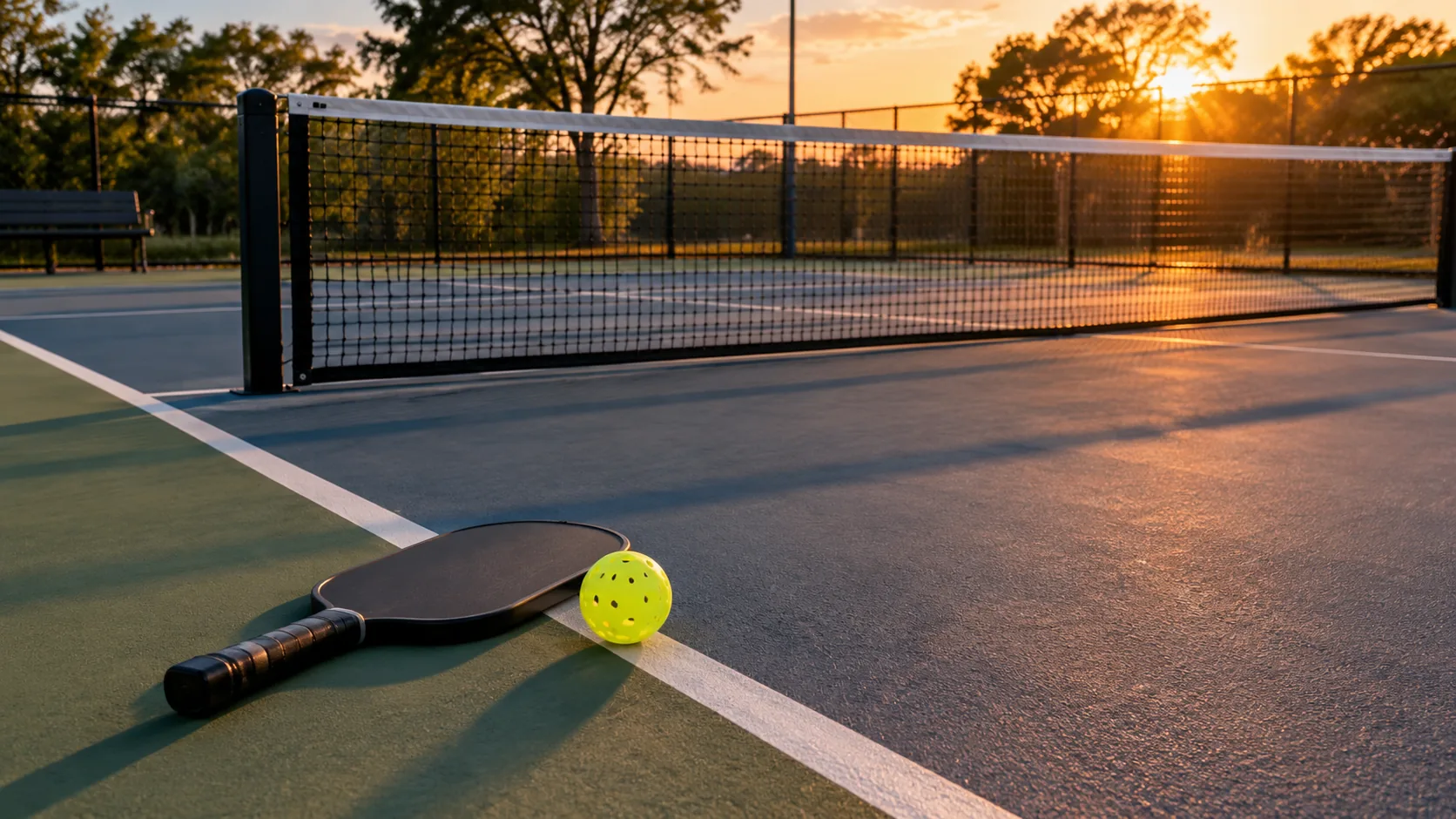
What is pickleball? It is a paddle sport played on a small court over a low net, using a solid paddle and a perforated plastic ball. Games are played to 11 points, the serve is underhand, and a short zone beside the net called the kitchen has its own rule. This guide walks through the basics in order.
Below you will find how the game works, the court layout, scoring in plain steps, the kitchen and double bounce rules, how pickleball compares with tennis and padel, and a checklist for choosing a first paddle.
What is pickleball and why is it called that?
Pickleball mixes elements of tennis, badminton and table tennis. It is played as singles or doubles. The paddle is solid and has no strings, and the ball is hollow plastic with holes.
The game was invented in 1965 in Washington state as a backyard pastime for a family and their friends. Two origin stories are told for the name: one points to a pickle boat, a rowing term for a crew made from leftover oarsmen, and the other to a family dog named Pickles. Treat either as a story rather than settled fact.
How a game works in plain steps
A rally starts with a serve and continues until someone faults. Here is the flow from the first serve to the final point.
- The serving player stands behind the baseline and serves underhand, diagonally across the court into the opposite service area.
- The receiving side lets the serve bounce once, then returns it.
- The serving side lets that return bounce once, then plays it. After these two bounces, players may volley, which means hitting the ball out of the air.
- The rally continues until one side faults, for example by hitting the ball into the net, out of bounds, or volleying from inside the kitchen.
- If the serving side wins the rally, it scores a point. If the receiving side wins, the serve passes on.
- The first side to reach 11 points and lead by 2 wins the game.
Only the serving side can score. Keep that idea in mind and the scoring in your first game will make more sense.
Pickleball court size and layout
The court is the same size as a doubles badminton court, which makes it much smaller than a tennis court. Painted lines mark the baselines, sidelines, the kitchen line and a centerline that splits the service areas. A ball that lands on a line is in.
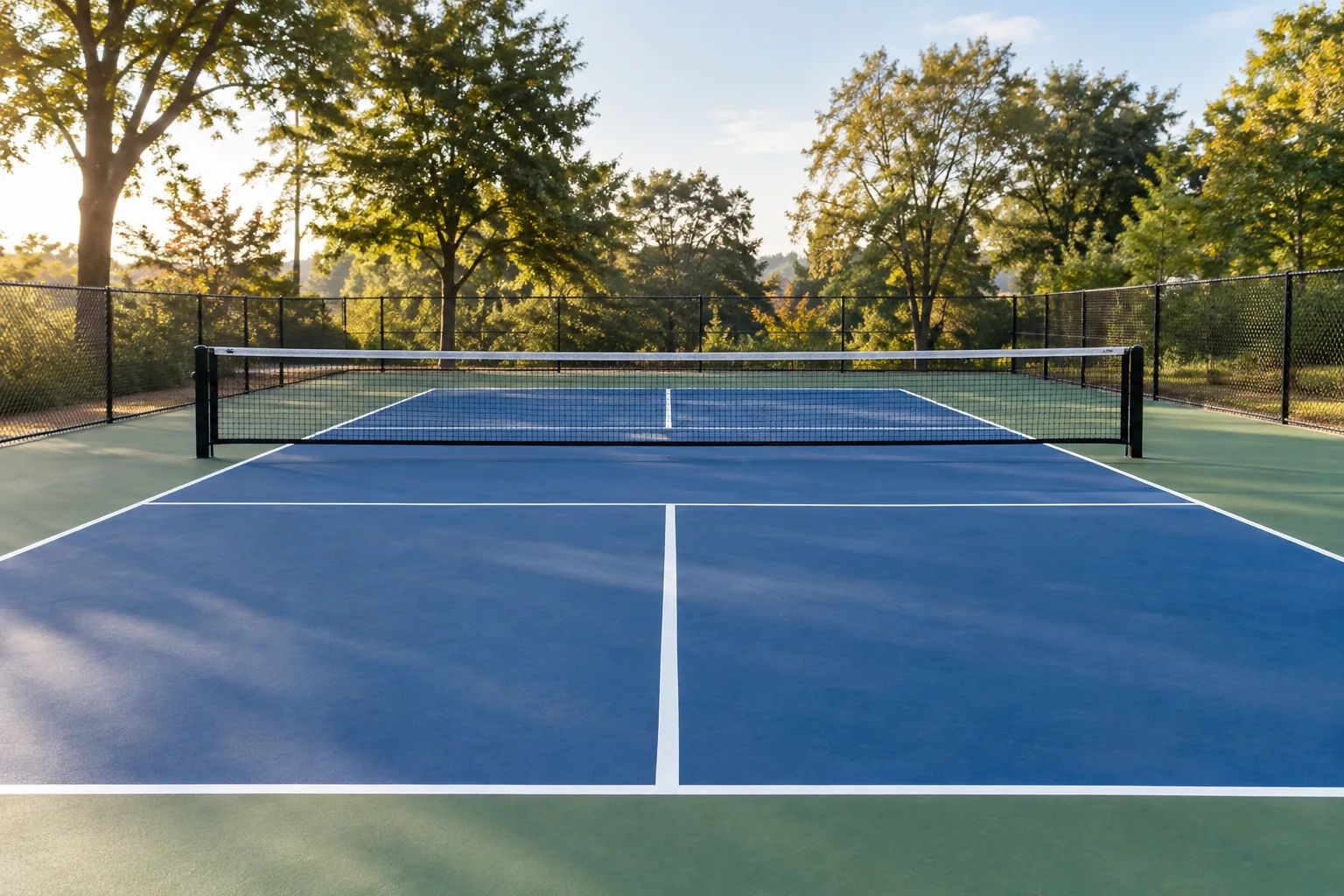
| Court feature | Measurement |
|---|---|
| Full court | 20 feet wide by 44 feet long |
| Kitchen (non-volley zone) | 7 feet deep on each side of the net |
| Service areas | Behind the kitchen line, split by the centerline on each side |
| Net height | 36 inches at the posts, 34 inches in the center |
Some tennis and recreation facilities paint pickleball lines over other courts, so check the lines before you start. A portable net can work on a driveway if the surface is flat and the space is clear.
The kitchen rule and the double bounce rule
These two rules give pickleball its shape.
The kitchen (non-volley zone)
The kitchen is the 7-foot strip on each side of the net. You may not volley the ball while standing in it or touching its lines, and your momentum cannot carry you into it after a volley. You can step into the kitchen to hit a ball that has already bounced there, then step back out.
The rule keeps players from standing at the net and smashing every ball. It is why soft shots called dinks, which drop into the opponent's kitchen, matter in the game.
The double bounce rule
Each side must let the ball bounce once before hitting it: the receiver on the serve, and the server on the return of that. After that, volleys are allowed outside the kitchen. Learn the double bounce rule early, because forgetting it is a frequent beginner fault.
Scoring and serving in doubles
Scoring feels odd for the first few games, so use the table as a cheat sheet.
| Situation | What happens |
|---|---|
| Serving side wins the rally | It scores one point and the same server switches sides and serves again |
| Serving side faults | The serve goes to the partner, or to the other team after both partners have served |
| Receiving side wins the rally | No point; only the serve changes |
| Start of the game | The first serving team has just one server before the serve passes |
| Calling the score | Server's score, receiver's score, then server number (1 or 2) |
| Game end | 11 points, win by 2 |
A score call such as "4-2-1" means the serving side has 4, the other side has 2, and the first server is up. Say it out loud before every serve so all four players agree.
Serving rules are also simple: the serve is underhand, the paddle contact happens below the waist, and the ball must clear the kitchen and land in the correct diagonal service area. Local groups sometimes vary details such as a serve that touches the net, so check the official rulebook if you play in a league.
Pickleball vs tennis and padel
The main difference between pickleball and tennis is scale and equipment. Pickleball uses a smaller court, a solid paddle, a plastic ball with holes, an underhand serve and a lower net. Tennis uses strung rackets, a larger court and allows an overhand serve.
Padel is a different sport again. It is played in an enclosed court where the ball can bounce off the walls, using a solid stringless racket and a pressurized ball. Pickleball has no walls, and padel has no kitchen rule.
| Feature | Pickleball | Tennis | Padel |
|---|---|---|---|
| Hitting tool | Solid paddle | Strung racket | Solid stringless racket |
| Ball | Perforated plastic | Felt-covered rubber | Pressurized ball |
| Serve | Underhand | Overhand allowed | Underhand |
| Walls in play | No | No | Yes |
How to choose a first pickleball paddle
A pickleball paddle for beginners does not need many features. Look for a face with a generous hitting area, a grip that fits your hand, and a weight you can swing for a full game. Use this checklist when you compare options.
- Grip size: the handle should fit your hand without squeezing. Some paddles let you select the grip size at checkout.
- Face size and material: a wider face gives a larger hitting area while you learn where to meet the ball. Carbon fiber and textured finishes are found on many paddles.
- Core: a polypropylene or polymer honeycomb core is a common design for the body between the two faces.
- Weight: pick a paddle you can hold in the ready position for several minutes without your wrist dropping. If thickness is listed in millimeters, compare it across paddles, since 14 mm and 16 mm paddles can feel different in the hand.
- Edge guard and cover: a cushioned edge guard or a carrying cover suits a court bag.
Two paddles we stock
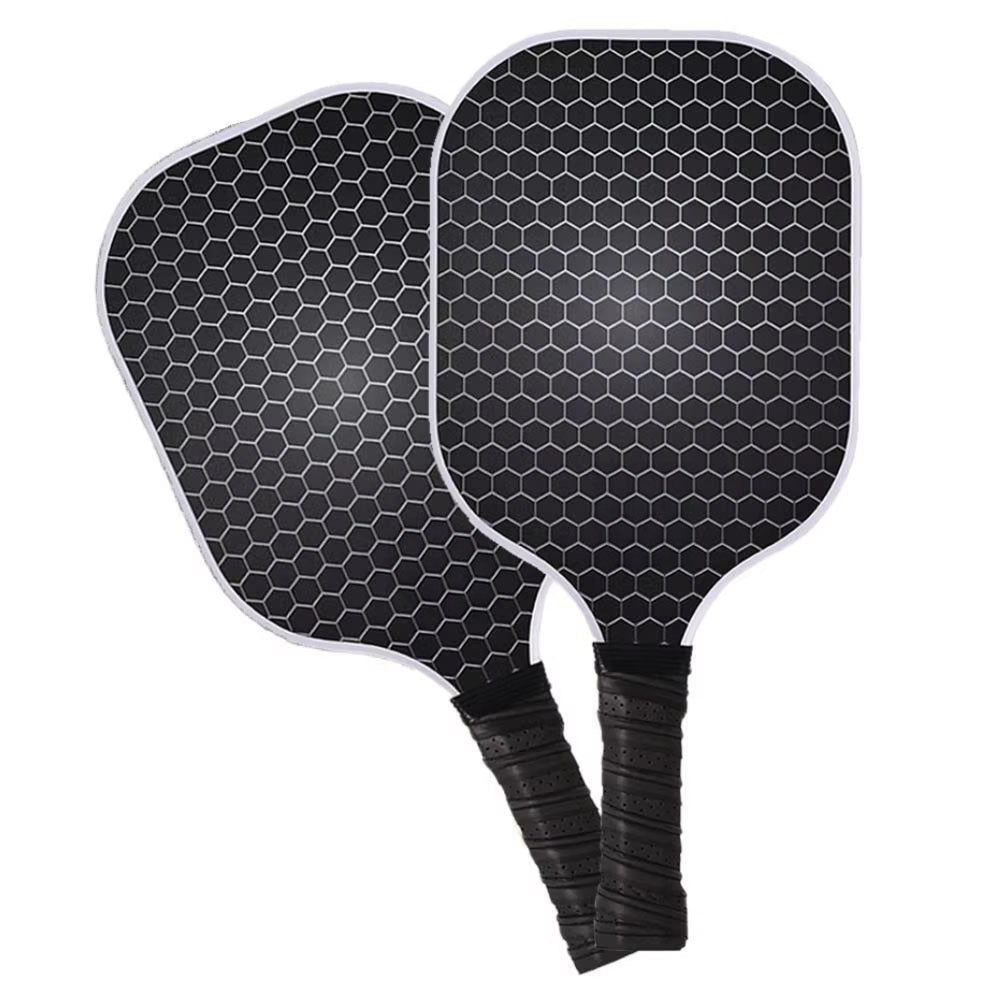
The CourtVantage has a textured carbon fiber face, a polypropylene honeycomb core, a cushioned edge guard and an ergonomic anti-slip grip. The face is extra-wide, and you choose the grip size when you order.
 In this guideCourtVantage$99.99View
The RallyCrest also has a textured carbon fiber face with a honeycomb polymer core. Its ergonomic grip has perforated anti-slip ridges, and a protective paddle cover is included for carrying to the court.
For balls, nets and other lawn and court extras, browse the Court, Golf & Backyard Games collection.
How to hold the paddle and take your first steps
Hold the paddle as if you were shaking hands with the handle, with the face upright. Keep a relaxed grip so the wrist can move, and stay in a ready position with the paddle in front of you at the kitchen line.
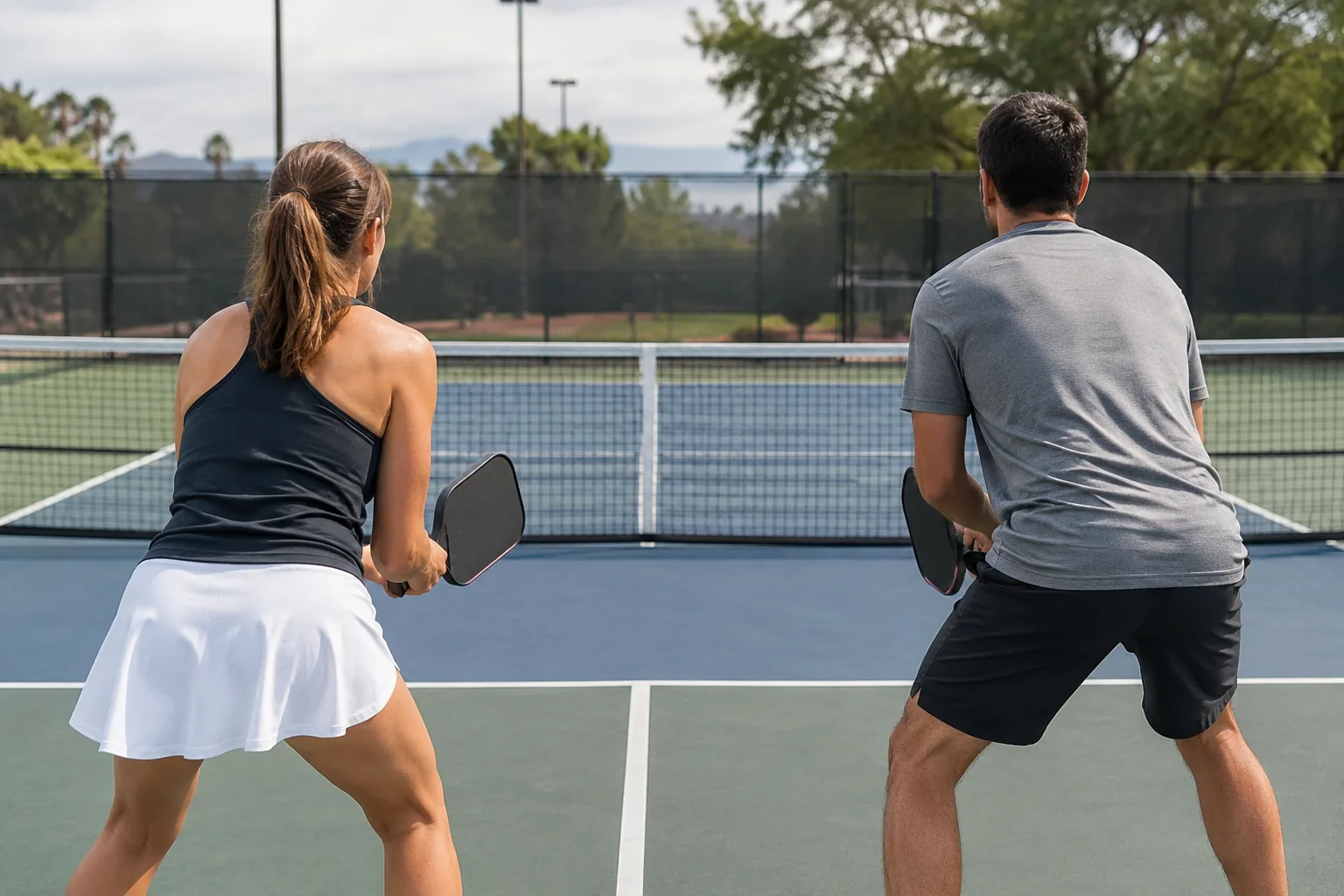
For your first session, follow this order:
- Warm up with easy rallies from the baseline, with no scoring.
- Practice the underhand serve until it lands in the service area.
- Play a few dinks from behind the kitchen line with a partner.
- Play a short game to 11, calling the score before each serve.
Wipe the face with a soft cloth after play to clear court dust, and store the paddle in a cover or bag.
Field note
Say the score out loud before every serve and let the ball bounce on the serve return. These two habits clear up many beginner disputes.
Common beginner mistakes
- Stepping into the kitchen after a volley, which is a fault.
- Forgetting the double bounce and volleying the return of serve.
- Serving overhand or above the waist.
- Gripping the handle too tightly, which limits wrist movement.
- Standing too deep and leaving the kitchen line to the other team.
Pickleball is a physical activity, so if you have a health condition or concerns about mobility, ask a healthcare provider before you start, and warm up before each session. To find games, check local recreation centers and parks for open play times.
Want to study your own play? Types of Camera Shots explains how to film with an action camera. If you also play on grass, Using a Rangefinder in Golf covers another course-and-court hobby.